Claude Fable 5 and Mythos 5: Anthropic's UK Launch
Anthropic has released a Mythos-class model to the public. Find out what Fable 5 does, how much it costs, and why Mythos 5 is restricted.
by Cleverson Gouvêa
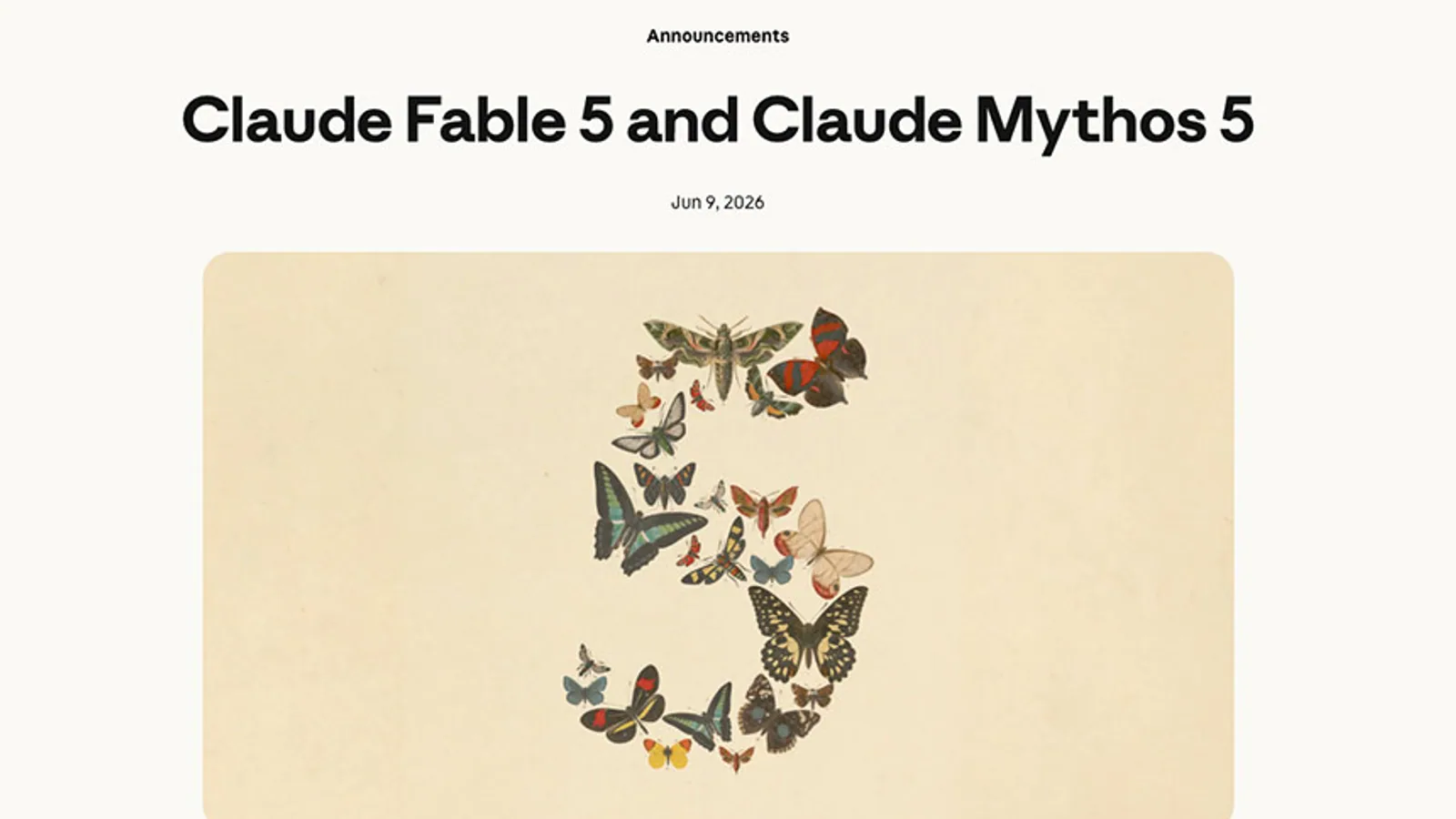
The Claude Fable 5 is the most powerful AI model Anthropic has ever released to the general public — and it comes with a restricted sibling, the Mythos 5. Announced on 9 June 2026, the two share the same brain but follow different paths. In this guide, I explain what each does, how much they cost, what the benchmarks show, and what this means in practice for UK software developers and business owners.
TL;DR
- Fable 5 is the public version, Mythos-class, with safety guardrails active.
- Mythos 5 is the same model with some guardrails removed, released only to cyber defenders and infrastructure providers via Project Glasswing.
- Price: £8 per million input tokens and £40 per million output tokens — less than half the cost of Claude Mythos Preview.
- State-of-the-art in nearly all tested benchmarks: software engineering, finance, vision, and scientific research.
- Guardrails only redirect responses to Opus 4.8 in fewer than 5% of sessions.
What is Claude Fable 5 — and why is it called "Mythos-class"
"Mythos" is the name Anthropic gives to its frontier generation — the most capable models the company can train, usually kept under controlled access for safety reasons. The Claude Fable 5 is the first time a model of this class has been made safe enough to be available to the public.
In practice, this means a leap in capability. According to Anthropic, Fable 5 is state-of-the-art in nearly all benchmarks it tested, with exceptional performance in software engineering, knowledge work, computer vision, and scientific research. It can also work autonomously for longer than any previous Claude and maintains persistent memory across millions of tokens of context.
For those following the model race, the message is clear: Anthropic is no longer keeping its best models only for internal teams and selected partners. What was once an expensive preview model has become a shelf product.
Fable 5 vs Mythos 5: the difference is in the guardrails
The most common confusion at launch is thinking Fable 5 and Mythos 5 are different models. They are not. It's the same underlying model — the difference is in the safeguards.
The three guardrails of Fable 5
Fable 5 runs with three safety classifiers that monitor what you ask:
- Cybersecurity — blocks offensive cyberattack tasks.
- Biology and chemistry — blocks most sensitive requests in these areas.
- Distillation — prevents attempts to extract the model's capability to clone its weights.
When one of these guardrails triggers, the question doesn't go unanswered: it is redirected to Claude Opus 4.8. And this happens rarely — more than 95% of Fable sessions do not trigger any fallback. For the average user, the experience is that of talking to the frontier model all the time.
What Mythos 5 unlocks
The Mythos 5 is the same model with some of these guardrails suspended, released to a small group of cyber defenders and infrastructure providers — and to selected biology researchers. Access is controlled and Mythos-class traffic has a 30-day data retention policy with privacy protections. It's not something you sign up for with a credit card: it's institutional access, by invitation.
Price: less than half the Mythos Preview
The pleasant surprise of the launch was the price. Both Fable 5 and Mythos 5 cost the same, and much less than expected for a frontier model.
| Model | Input (£/million tokens) | Output (£/million tokens) |
|---|---|---|
| Claude Fable 5 | 8 | 40 |
| Claude Mythos 5 | 8 | 40 |
| Claude Mythos Preview | more than double | more than double |
The price — £8 input and £40 output per million tokens — is less than half what Claude Mythos Preview cost. In an area where the norm has been to charge more for the strongest model, lowering the price of the top-tier model changes the economics for product builders. Applications that previously only made sense with a weaker model now fit within budget using the best Anthropic offers.
It's worth remembering the basic token arithmetic: output costs five times input. In workflows that generate long texts — reports, code, lengthy responses — the cost lives in the output. It pays to design concise prompts and objective responses.
What the benchmarks really show
Marketing aside, some concrete results help calibrate expectations:
- Finance: Fable 5 has the highest score of any model on Hebbia's Finance Benchmark and aced trading analysis evaluations across nearly the entire line.
- Biology: in an AAV (adeno-associated virus) design evaluation, Mythos 5 outperformed sophisticated models dedicated to protein tasks.
- Game agents: Fable beat Pokémon FireRed with a minimal framework, using only vision — while previous Claude models required a complex set of auxiliary tools.
- Attack resistance: an external bug bounty programme found no universal jailbreak on the cybersecurity classifiers in over 1,000 hours of testing.
None of these numbers promise the model gets everything right. But they paint a consistent picture: a model strong in technical reasoning, capable of operating as an agent with little scaffolding, and hard to break. If you want to understand how AI agents are changing work in businesses, it's also worth reading what Gemini Spark changes for companies.
Project Glasswing: cybersecurity with the US government
Mythos 5 debuts within Project Glasswing, an initiative in collaboration with the United States government to put a frontier model in the hands of those defending critical infrastructure.
The logic is that of playing from a position of advantage. Attackers don't respect guardrails — they'll use the most capable AI they can get. If defenders are stuck with a model weakened by safeguards, they start the game behind. By releasing Mythos 5 (without some cybersecurity guardrails) only to a verified group of cyber defenders and infrastructure providers, Anthropic tries to balance the scales without spreading offensive capability to the public.
It's a deliberate bet: concentrate raw power in those with a mandate to defend, and keep the rest of the world on the Fable version, with guardrails in place. The design echoes the security debates we've seen around software supply chains — a topic we covered in Infected NPM packages and the Shai-Hulud case.
The Stripe case: 50 million lines migrated in one day
The example that circulated most at launch came from Stripe. During initial testing, the company reported that Fable 5 "compressed months of engineering into days": it performed a migration that swept the entire codebase — 50 million lines of Ruby — in a single day, something that would take an entire team more than two months.
Stripe is not alone. Among the partners that tested the model early are names like GitHub, Cursor, Scale AI, and Replit — most of them linked to development and coding tools. That's no coincidence: Fable 5's strongest point is precisely operating as an agent in end-to-end software tasks.
For developers, the signal is clear. Migrations, large refactorings, and technical debt that sat in the queue for lack of people are now candidates to be done by an agent, with human review. It's the same movement we've already discussed when talking about agentic IDEs in Google Antigravity 2.0.
What changes for UK businesses
Fable 5 is powerful, but it's not the answer to everything. Before throwing your entire budget at it, it's worth separating where it shines from where it doesn't pay off.
When to use Fable 5:
- Complex engineering tasks: migration, code generation and review, automation of long workflows.
- Dense document analysis, finance, and research, where reasoning depth justifies the token cost.
- Agents that need to work autonomously for many steps without losing the thread.
When NOT to use it:
- Simple, high-volume tasks (classification, field extraction, FAQ answering): a smaller, cheaper model will do.
- Cases that hit the cybersecurity or biology guardrails — the request falls back to Opus 4.8 and behaviour changes.
- Operations sensitive to per-call cost at million-scale: do the output maths first.
A common trap is treating the strongest model as the default for everything. The healthy approach is routing: Fable 5 for tasks that require the top tier, smaller models for the rest.
In the projects I run here at Agathas Web, this routing is what separates a pilot that pays for itself from one that becomes a budget hole. In over 15 years dealing with infrastructure and development, I've learned that the right question is never "which is the strongest model?", but rather "what is the most expensive task I do manually today that a reliable agent could take over?". Fable 5 is only worth the output price when it answers that question — in complex code, dense analysis, and long workflows. For the rest, keeping a cheap model in the router saves more than any volume discount.
If you're comparing generative AI options for your business, the landscape of the direct competitor is in Google Gemini: what changed at I/O 2026.
How to start using Fable 5 today
Fable 5 is already available globally via the Anthropic API and in Claude products. To get started without burning your budget, follow a simple order:
- Start small. Choose one real, expensive-to-do-manually task — a refactoring, a recurring report — and measure the result against your current process.
- Measure output cost. Run a few real cases and project the spend per thousand executions before scaling.
- Design routing. Define which requests go to Fable 5 and which go to a smaller model.
- Have a human reviewer. For code and sensitive decisions, the productivity gain doesn't replace the eye of someone who knows the subject.
You don't need to rewrite your stack to take advantage of the model. Start with one use case, validate the return, and expand.
Conclusion
The Claude Fable 5 marks the moment Anthropic decided to put its frontier model in the hands of any developer — with intelligent guardrails that almost never get in the way — while reserving Mythos 5, without some of those guardrails, for those defending critical infrastructure. Half the price of Mythos Preview, top-tier performance in engineering, and a real-world case of migrating 50 million lines in one day: it's easy to see why the launch shook the market.
If your business runs on software or processes that could become agents, this is a good time to test. Need help figuring out where AI really pays off in your business? Get in touch with Agathas Web and we'll map it out together.
Related posts

AI ROI for UK Businesses: Measuring Impact Beyond the Pilot
80% feel AI helps, but only 37% see profit impact. Here's a roadmap to measure, calculate total cost, and decide what to automate.

AI Agents for Businesses: From Pilot to Production in 2026
80% of large Brazilian companies have already reversed an AI deployment. Discover common pitfalls and how to build a resilient pilot.

AI Definition 2026: What UK Businesses Need to Know
Is your chatbot AI in the eyes of the law? Three 2026 regulations hinge on that answer—and most UK companies aren't ready.