NVIDIA RTX Spark: The AI Superchip Arrives on Windows in the UK
Announced at Computex 2026, the RTX Spark puts an AI data centre inside a laptop. Discover the GB10 chip, partners, and what it means for UK businesses.
by Cleverson Gouvêa
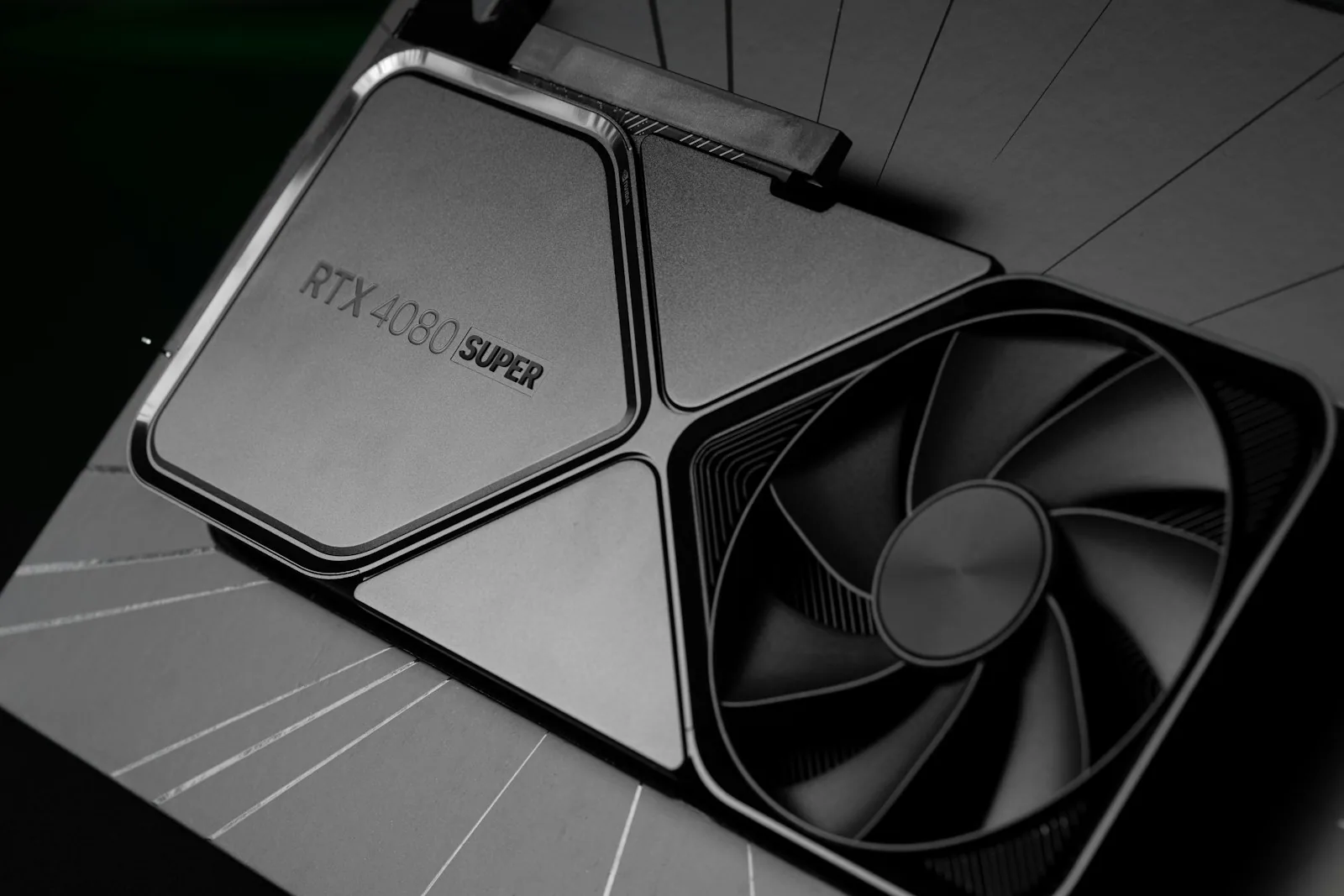
The NVIDIA RTX Spark is the company's boldest move in a decade: for the first time, the Grace Blackwell superchip — the same DNA as AI data centres — will fit inside a Windows laptop. Announced by Jensen Huang at Computex 2026, it promises to run AI models with up to 200 billion parameters locally, without the cloud.
TL;DR
- What it is: the RTX Spark (N1X chip) brings the GB10 Grace Blackwell superchip to Windows laptops and mini PCs.
- Announcement: revealed by Jensen Huang during the GTC Taiwan keynote at Computex 2026 on 1 June 2026.
- Specs: up to 20 Arm cores, Blackwell GPU with up to 6,144 CUDA cores, 128 GB unified memory, and up to 500 TFLOPS in FP4.
- Partners: over 30 laptops from Dell, HP, Lenovo, Microsoft (Surface), Asus and MSI, plus around 10 compact desktops.
- Availability: autumn in the northern hemisphere (second half of 2026). Price not yet confirmed.
- Target audience: developers, creators, and businesses that want to run AI locally without relying on cloud GPUs.
What is the RTX Spark and why does it matter?
Until now, NVIDIA dominated the PC through graphics cards. The RTX Spark changes the game: instead of just supplying the GPU, the company delivers the entire heart of the computer — CPU, GPU and memory in a single package. This is what the industry calls a SoC (System on a Chip), the same philosophy as smartphone chips, but with data centre power.
The name is no coincidence. The RTX Spark is the consumer version of the DGX Spark, the 'personal AI supercomputer' that NVIDIA launched in October 2025 (NVIDIA{target="_blank"}). The key difference: the DGX Spark runs Linux and targets AI engineers; the RTX Spark runs Windows and targets the premium laptop and mini PC market.
Why does this matter? Because it puts AI inference capability — running models like DeepSeek, Llama and Gemma directly on the machine — on the desks of those who previously depended on cloud servers. No network latency, no per-token cost, no sending sensitive data off-device. For UK businesses handling confidential information, this is a game-changer, especially with ICO guidance on data protection.
Inside the GB10 Grace Blackwell superchip
Arm CPU and Blackwell GPU on the same silicon
The brain of the RTX Spark is the GB10 superchip — in its consumer variant, called N1X. It was co-designed with MediaTek and manufactured on TSMC's 3-nanometre process, combining two worlds in one package: an Arm CPU complex and a Blackwell GPU, the same architecture as NVIDIA's most expensive AI accelerators.
Unified memory: the clever trick
The technical masterstroke is unified memory. Instead of separating system RAM from video memory, the RTX Spark shares 128 GB between CPU and GPU. This allows loading massive AI models — up to 200 billion parameters — without the bottleneck of copying data back and forth.
| Component | Specification (RTX Spark / GB10) |
|---|---|
| CPU | Up to 20 Arm cores (ARMv9), co-designed with MediaTek |
| GPU | Blackwell, up to 6,144 CUDA cores |
| Memory | 128 GB unified LPDDR5x (CPU + GPU) |
| AI performance | Up to 500 TFLOPS in FP4 (1 PFLOP with sparsity) |
| Process | TSMC 3 nm class |
| Operating system | Windows |
A word of caution: NVIDIA used the phrase 'up to' liberally. In practice, not every RTX Spark laptop will come with all 20 cores or 6,144 CUDA cores active — manufacturers are expected to segment versions by price and power consumption.
RTX Spark vs DGX Spark: what's the difference?
The names are similar and cause confusion. This table clears it up:
| DGX Spark | RTX Spark | |
|---|---|---|
| Audience | AI engineers and researchers | Premium consumers and businesses |
| OS | DGX OS (Ubuntu 24.04) | Windows |
| Form factor | Mini desktop workstation | 14" to 16" laptops and mini PCs |
| Launch | October 2025 | Autumn 2026 |
| Price | US$3,000–4,000 (now ~US$4,699) | To be confirmed |
| Focus | Prototyping and training models | Everyday local AI and creation |
In short: same engine, different packaging. Those who followed the NVIDIA AI paradox on the Nintendo Switch 2 already know the company is a master at reusing an architecture in products from opposite markets — from console to workstation.
Why NVIDIA entered the PC market now
The timing is no accident. For years, Windows on Arm was largely a Qualcomm fiefdom, thanks to an exclusivity agreement with Microsoft. With that contract expiring, the door opened for NVIDIA to field its own Arm chip on Windows — something the company had been rehearsing since the Denver project.
The RTX Spark is the answer. NVIDIA doesn't just want to sell GPUs for Intel and AMD laptops; it wants to be the entire platform — CPU, GPU and software. And there's a narrative behind it: Jensen Huang talks about turning Windows into an 'agentic operating system', where AI agents run continuously in the background, anticipating tasks. It's the same movement we described in AI agents for businesses — only now the processing happens inside the device itself, not on a distant server.
What local AI means for UK businesses
For the UK market, the RTX Spark addresses three concrete pain points:
- Predictable cost: cloud AI is billed per token or per GPU hour. With the RTX Spark, the cost is the hardware — paid once. For teams processing large amounts of data, the payback is quick.
- Privacy and UK GDPR: sensitive data (legal, health, financial) never leaves the machine. This simplifies compliance with the Data Protection Act 2018 and reduces the risk surface.
- Connection independence: local inference doesn't stall when the internet goes down or the provider's API goes offline.
In practice, imagine an office using the RTX Spark to generate images and videos with AI locally — something many currently do in the cloud, as we showed in our guide to ComfyUI on Google Colab. The difference is removing the dependency on Colab and bringing the entire pipeline in-house.
The 128 GB of memory is precisely what enables models that don't fit in a typical laptop GPU. A quantised 70-billion-parameter model, for example, requires tens of gigabytes just to load — territory where 8 or 12 GB cards simply cannot reach. That's why NVIDIA insists on the 200-billion-parameter figure: it defines the boundary of what the machine can run without cloud assistance.
It's not for everyone, of course. If you only use a sporadic chatbot, you don't need 128 GB of unified memory. The RTX Spark makes sense for those who run AI frequently and at scale — agencies, technical offices, product and development teams.
Partners, price and availability
NVIDIA won't manufacture the laptops alone. According to the announcement, more than 30 models based on the RTX Spark are expected from six manufacturers: Dell, HP, Lenovo, Microsoft (with the Surface line), Asus and MSI. Add to that around 10 compact desktops (The Register{target="_blank"}).
The launch window is autumn in the northern hemisphere — that is, the second half of 2026. The first devices described are 14- to 16-inch laptops with aluminium chassis and OLED G-Sync displays.
On price, NVIDIA did not confirm figures for the RTX Spark at Computex. The closest reference is the DGX Spark, which launched between US$3,000 and US$4,000 and now costs around US$4,699. It's safe to expect the first generation of RTX Spark to be premium — not an entry-level laptop. In the UK, expect prices to be in the region of £2,500–£4,000 once VAT is added.
The roadmap: what comes after GB10
The RTX Spark is not a standalone product — it's the first step in a three-generation plan that NVIDIA detailed at Computex 2026, according to Tom's Hardware{target="_blank"}:
- Generation 1 — GB10 / N1X (2026): the current RTX Spark, with LPDDR5x memory.
- Generation 2 — Rubin: a leap to LPDDR6 memory, with more bandwidth for larger models.
- Generation 3 — Feynman class: the long-term bet, with no announced date yet.
The message to buyers is clear: the 2026 RTX Spark is the beginning of a platform, not a disposable experiment. Those who invest now enter an ecosystem with planned continuity.
RTX Spark vs Apple and AMD: the unified memory advantage
NVIDIA is not the first to bet on unified memory in a consumer chip. Apple has done this since the M1 processors, and AMD entered the fray with the Ryzen AI Max+ 395, which also shares memory between CPU and GPU. The RTX Spark's differentiator is the CUDA ecosystem: the vast majority of AI tools — PyTorch, inference frameworks, Hugging Face models — are born optimised for NVIDIA GPUs. On an Apple machine, much of this software needs adaptation; on the RTX Spark, it runs natively.
In early tests with the DGX Spark, which uses the same GB10, Tom's Hardware noted performance superior to AMD's Ryzen AI Max+ 395 in AI workloads. It's a sign of where the RTX Spark is aiming: to be the most straightforward option for those already living inside the NVIDIA ecosystem and wanting to take it to a laptop without rewriting their workflow.
The point no one should ignore is power consumption. Squeezing a Grace Blackwell superchip into a laptop chassis imposes real thermal limits. That's why NVIDIA talks so much about 'up to' in the specs: the version in a slim 14-inch laptop won't deliver the same as a compact desktop with more room for heat dissipation. When buying, the number of active cores and TDP will matter as much as the brand on the lid.
Is it worth waiting for the RTX Spark?
It depends on your use case. If you run generative AI every day — fine-tuning, image generation, autonomous agents — the RTX Spark could pay for itself in a few months by eliminating cloud bills and protecting your data. If your usage is light, a traditional laptop with a good GPU will suffice for a fraction of the price.
Most importantly: the arrival of the RTX Spark signals that local AI is no longer a niche. In 12 months, running powerful models on your own machine should be as common as opening a browser. It's worth watching closely, comparing manufacturers' versions when they launch, and measuring your real use case before spending.
At Agathas Web, we follow this movement to guide our clients on when it makes sense to invest in local AI and when the cloud is still the best choice. If your company is weighing this decision, get in touch — the right answer depends on your numbers, not the hype.
Related posts

AI Agents for Businesses: From Pilot to Production in 2026
80% of large Brazilian companies have already reversed an AI deployment. Discover common pitfalls and how to build a resilient pilot.

AI Definition 2026: What UK Businesses Need to Know
Is your chatbot AI in the eyes of the law? Three 2026 regulations hinge on that answer—and most UK companies aren't ready.

Midjourney V8.2: AI Ad Creatives for UK Marketers in 2026
Draft mode, V8.2, commercial licence and the billion-dollar Hollywood lawsuit: a practical guide to Midjourney for anyone producing ad creatives.