iPhone 18: Camera, Face ID & Price Leaks – UK Guide 2026
The iPhone 18 picture is almost complete from leaks. We separate the probable from the speculative: camera, Face ID, 2nm chip, colours and price.
by Cleverson Gouvêa
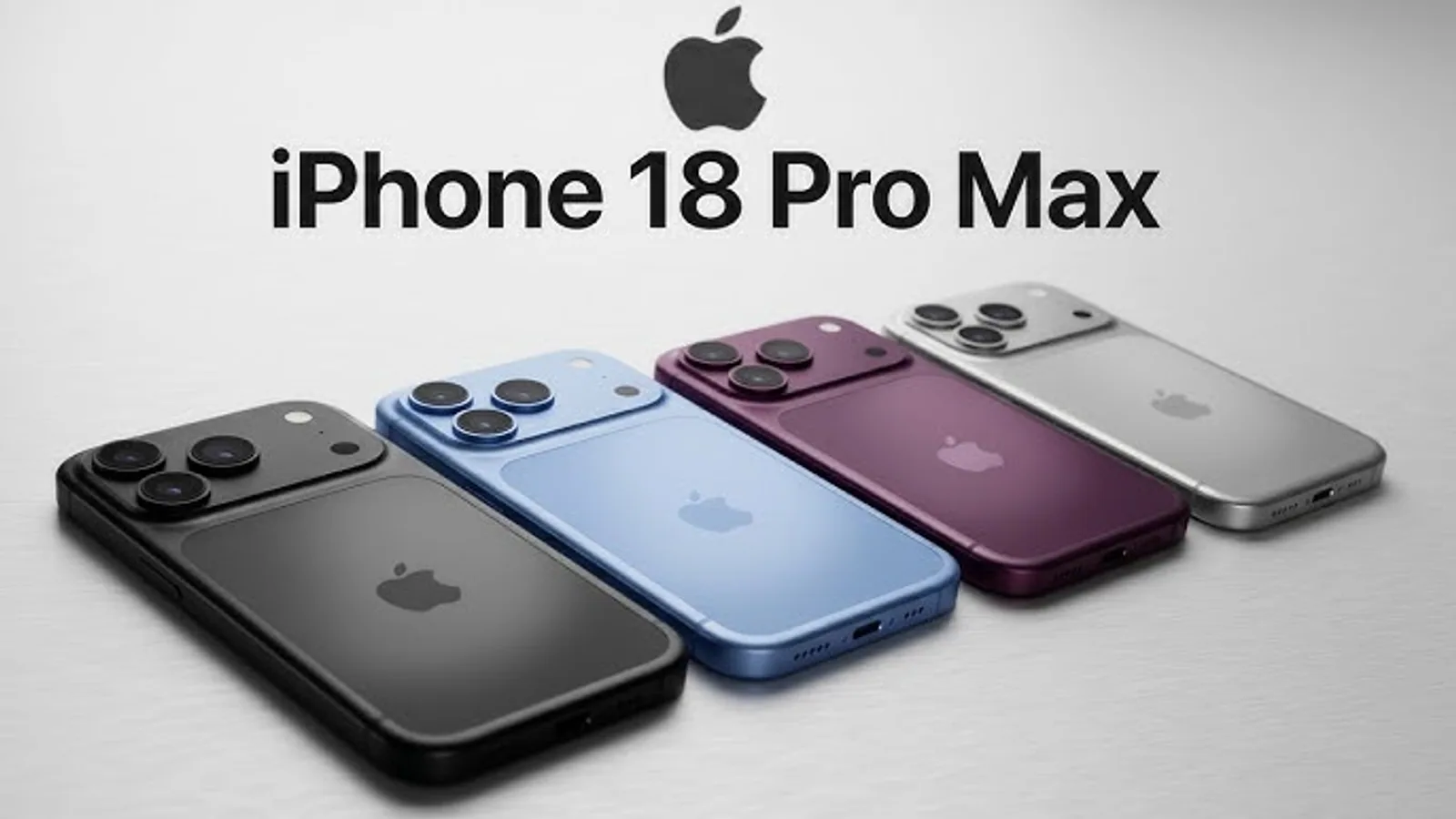
The iPhone 18 leaks have already sketched the device months before the official announcement: a camera with mechanical variable aperture, under-display Face ID and a 2-nanometre chip. We've gathered here what has leaked from reliable sources up to June 2026, separating what is probable from what is still loose speculation – so you can decide whether it's worth waiting.
TL;DR – what the leaks point to:
- Staggered launch: Pro, Pro Max and the foldable iPhone in September 2026; standard model and 18e in spring 2027.
- Camera: variable aperture via mechanical iris (f/1.6 to f/22 on Pro Max), a first for the line.
- A20 Pro chip: TSMC 2nm, ~15% faster and ~30% more efficient, with Neural Engine focused on on-device AI.
- Design: under-display Face ID and smaller Dynamic Island – but leakers disagree.
- Price: analysts differ; most likely scenario is stability or a minimal increase.
Each year the cycle repeats: renders, CAD schematics, factory dummies and Chinese leakers piece together the next iPhone before Apple says a word. As a CTO and mobile developer, I've followed these cycles for over a decade – and I've learned to read leaks with calibrated scepticism. Not everything is confirmed, but patterns that appear across multiple sources tend to be solid. That's the filter I apply below.
When the iPhone 18 arrives in shops
The most important news from the leaks isn't a spec – it's the calendar. For the first time, Apple is reportedly splitting the line into two launches. The Pro, Pro Max and the first foldable iPhone debut in September 2026, on the brand's traditional schedule. The standard model, the iPhone 18e and a possible second-generation iPhone Air would come in spring 2027 (autumn in the Northern Hemisphere).
This changes how you buy. Those who want the top-of-the-line follow the usual rhythm. Those aiming for the entry model need to wait longer. For the UK market, where the device arrives weeks or months later, this staggering tends to stretch the queue for the basic model even further. If you plan to upgrade your phone at the end of 2026, in practice the choice is limited to the Pro or the foldable.
Variable aperture camera: the biggest bet from the leaks
If one single item sums up why the iPhone 18 leaks have caused such a stir, it's the camera. For the first time, Apple would use a true variable aperture – not a software-simulated effect, but a mechanical iris with physical blades, like professional cameras.
Reports point to a range of f/1.6 to f/22 on the Pro Max, compared to the fixed f/1.78 aperture of current generations. In practice, this means real optical control over depth of field and light intake. Instead of blurring the background by algorithm, the sensor actually closes or opens the iris.
What changes in practice for photographers
Why does the iPhone 18's variable aperture matter? Three concrete gains:
- More natural portraits: the blur comes from optics, not a software mask that sometimes misses hair edges.
- Sharper landscapes: closing the aperture (f/16, f/22) increases depth of field, keeping from foreground to horizon in focus.
- Creative control: serious photographers gain a parameter that previously only existed on dedicated cameras.
It's the kind of change Apple likes to turn into a marketing campaign. Worth remembering: for now, it's a leak. The mechanical iris is a delicate and expensive part to produce at scale.
Under-display Face ID and the future of the Dynamic Island
Here lies the most disputed part of the leaks. The general direction is clear: Apple wants to hide Face ID under the panel. The flood illuminator, responsible for projecting the depth dots, would go under the screen. The front camera, in turn, would move to a discreet hole in the top-left corner.
The consequence would be a much smaller Dynamic Island. Leaker Ice Universe claims the cutout would be about 35% narrower – something like 13.5mm, compared to the current ~20.7mm on current models. More usable screen, less visual interruption.
The counterpoint comes from another respected source: Digital Chat Station maintains that the reduction would only arrive on the iPhone 19, and that the 18 Pro would keep the current island. CAD renders from May reinforce the smaller island version, but CAD reflects prototypes, not the final production decision. Treat it as probable, not confirmed. It's exactly the kind of detail that changes in the final stretch.
A20 Pro chip at 2nm: performance and on-device AI
The heart of the device would be the A20 Pro, manufactured by TSMC on the unprecedented 2-nanometre process. The smaller the lithography, the more transistors in the same space – and the leaks translate that into ~15% more performance and ~30% better energy efficiency compared to the previous generation.
There's an interesting architectural detail: the RAM would be integrated on the same wafer as the CPU, GPU and Neural Engine. This packaging reduces latency and power consumption, which helps sustain heavy tasks – like running the mechanical iris camera and AI models at the same time without draining the battery.
And that's where artificial intelligence comes in. The declared focus of the Neural Engine is on-device processing for Apple Intelligence and a revamped Siri, with real-time translation and AI-assisted camera features – all running on the device, without sending data to the cloud. We've already unpacked this point in our post about the A20 Pro chip and the iPhone 18 launch, and the same on-device AI logic appears in iOS 26 with Liquid Glass and Apple Intelligence.
LTPO+ display, battery and the eSIM detail
On the Pro models, leaks mention an LTPO+ display, an evolution of the current LTPO, more efficient at controlling variable refresh rate – which translates to battery savings on the always-on display and scrolling.
Speaking of battery, a curious and revealing number has emerged about strategy: the iPhone 18 Pro would have 4,056 mAh on versions with a physical SIM and 4,288 mAh on eSIM-only versions. The difference exists because removing the physical SIM tray frees up internal space for a larger cell. It's a subtle push towards eSIM – those who accept giving up the nano-SIM gain battery life. For comparison, the 17 Pro had about 4,252 mAh.
| Specification | iPhone 17 Pro (current) | iPhone 18 Pro (leaked) |
|---|---|---|
| Chip lithography | 3nm | 2nm (A20 Pro) |
| Camera aperture | f/1.78 fixed | f/1.6–f/22 variable |
| Face ID | Dynamic Island | Under display (probable) |
| Display | LTPO | LTPO+ |
| Battery (eSIM) | ~4,252 mAh | ~4,288 mAh |
Sizes follow the recent pattern: 6.3 inches on the Pro and 6.9 inches on the Pro Max.
New colours: Dark Cherry arrives, Cosmic Orange departs
Colour is a detail that defines iPhone generations in public memory – think of the purple of the 11 or the titanium of the 15. For the 18 Pro, the star would be Dark Cherry, described as a deep burgundy with a slight purplish tint. The leaked catalogue also includes Light Blue, Dark Gray and Silver.
In compensation, Cosmic Orange and Deep Blue would be discontinued. It's Apple's usual rotation: retire the colours of the previous generation to create desire for the new. If you love the orange of the current model, the leaks suggest the window to buy it is closing.
Standard iPhone 18, 18e and the foldable iPhone
The complete line, model by model
The leaks don't stop at the Pro models. There's movement across the entire iPhone 18 family:
- Standard iPhone 18: would be recategorised upwards, inheriting 12GB of RAM, a 24MP front camera and a brighter display. A leap over the 17.
- iPhone 18e: Apple's entry-level bet, positioned for spring 2027.
- Foldable iPhone: the big debutant. Internal display of about 7.8 inches, OLED panel designed to minimise the crease, and around 5.5 inches when folded.
The foldable would also be the most expensive in the brand's history: reports point to a starting price above $1,999. It's Apple's late but characteristic entry into a format that Samsung and Chinese manufacturers have explored for years. The difference, as always, would be less in the hardware and more in the ecosystem integration.
iPhone 18 price: will it go up?
The question everyone asks. And here the analysts themselves diverge – a sign that no one is certain.
- Ming-Chi Kuo believes Apple won't raise the price of the Pro models, absorbing the extra cost of memory to gain market share.
- Jeff Pu mentions an "aggressive pricing strategy", but also projects a starting price equal or with a minimal increase, despite the global memory shortage.
In other words: the possible consensus is stability or a small increase on the Pros. The outlier is the foldable, which is born premium by definition. For the UK consumer, the deciding factor remains exchange rates and VAT – variables that no leak from Cupertino can predict.
How to read leaks without getting frustrated
After many cycles, a practical rule emerges: a leak that appears in multiple independent sources tends to be confirmed; a rumour from a single source becomes noise. The 2nm chip, the variable aperture camera and the staggered calendar match multiple reports – they are safe bets. The exact size of the Dynamic Island and the final colours change until the week of the announcement.
For businesses and creators who depend on mobile, the useful reading isn't "which colour to buy", but where the platform is heading: more on-device AI, computational camera turning into true optical camera, and the ecosystem betting heavily on device privacy. This direction matters more than any millimetre of screen cutout. Those already following the AI race in phones can compare with what we mapped in Xiaomi 17 Pro Max and its Leica camera.
Is it worth waiting for the iPhone 18?
If you're using a model two or three generations old and you photograph a lot, the iPhone 18 leaks give real reasons to wait until September 2026: the variable aperture camera and the 2nm chip are genuine leaps, not incremental. If your current device does the job, there's no urgency – and prices of the previous generation usually drop soon after the announcement.
Our usual advice: decide by need, not by rumour hype. The iPhone 18 leaks are a useful map, not a contract – Apple may still cut features, delay the design or surprise with something no one predicted. When the official announcement comes, we'll be back to confirm or deny each of these points, side by side with what actually arrives in shops.
Need help choosing mobile technology with a business mindset – from the device to the app that runs on it? That's exactly the kind of conversation Agathas Web likes to have, combining technical vision with a results-oriented outlook.
Related posts

AI Agents for Businesses: From Pilot to Production in 2026
80% of large Brazilian companies have already reversed an AI deployment. Discover common pitfalls and how to build a resilient pilot.

AI Definition 2026: What UK Businesses Need to Know
Is your chatbot AI in the eyes of the law? Three 2026 regulations hinge on that answer—and most UK companies aren't ready.

Midjourney V8.2: AI Ad Creatives for UK Marketers in 2026
Draft mode, V8.2, commercial licence and the billion-dollar Hollywood lawsuit: a practical guide to Midjourney for anyone producing ad creatives.