Apple’s New Siri with Gemini: What It Means for UK Users at WWDC 2026
Apple’s new Siri, unveiled at WWDC 2026, runs on a 1.2 trillion-parameter Google Gemini model. Here’s what’s confirmed, what’s rumoured, and how it affects UK businesses.
by Cleverson Gouvêa
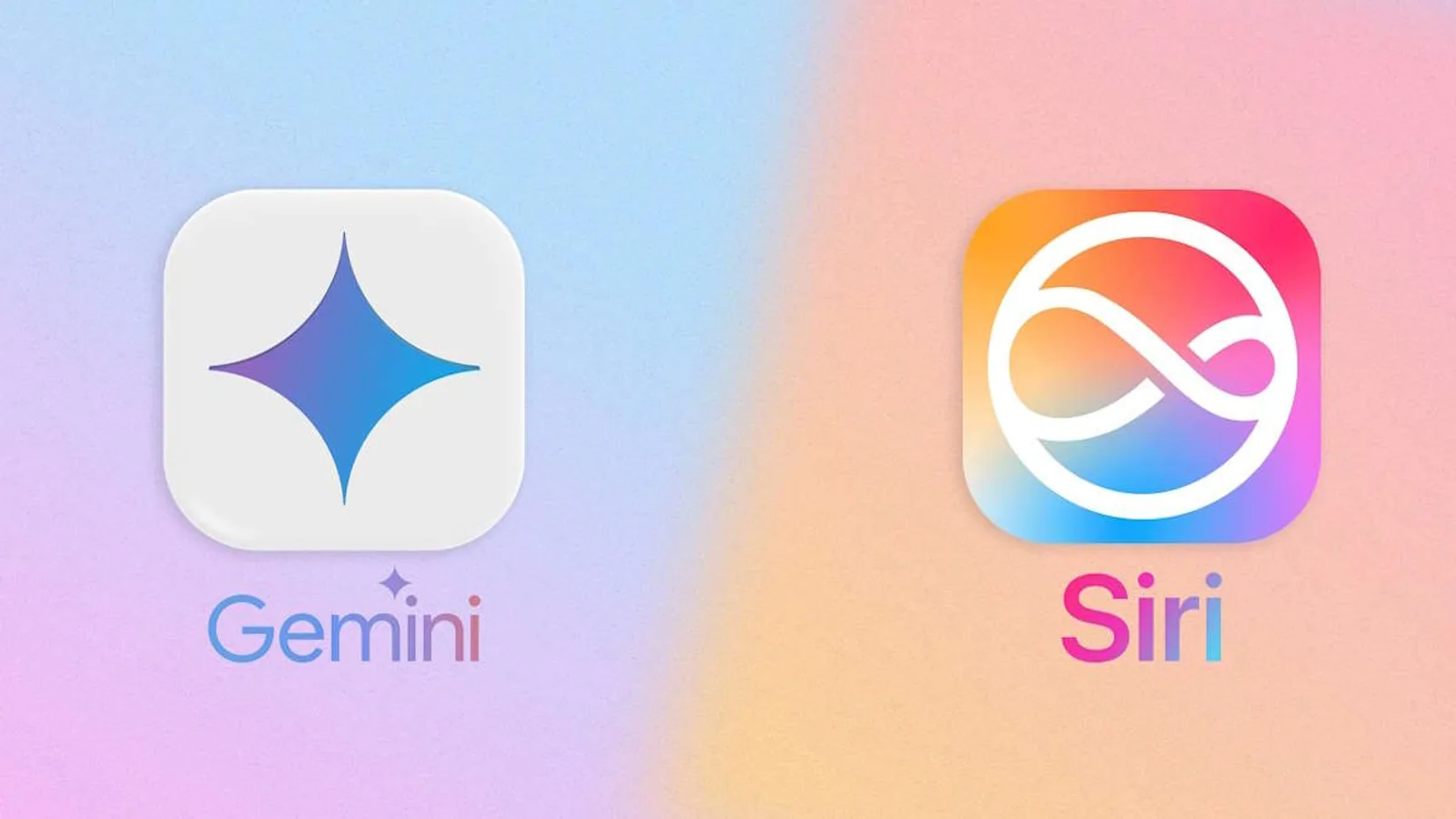
The new Siri Apple showcased at WWDC 2026 is the biggest overhaul of the assistant in over a decade — and it no longer relies solely on Apple’s own technology. Behind the more natural responses is a 1.2 trillion-parameter Google Gemini model. In this guide, we separate confirmed facts from rumours and show what changes in practice.
TL;DR
- The new Siri was unveiled at WWDC 2026 on 8 June as a conversational, multimodal assistant capable of performing tasks within apps.
- It now runs on a custom Google Gemini model with 1.2 trillion parameters — roughly eight times larger than Apple’s current cloud model.
- According to Bloomberg, Apple is paying around $1 billion per year to Google for access to the model.
- Features will roll out gradually throughout 2026, likely alongside iOS 27.
- Sensitive processing remains on Private Cloud Compute, with an option to automatically delete history.
What Apple announced about the new Siri
Apple used WWDC 2026 on 8 June to show a Siri practically rebuilt from scratch. The promise is to leave behind the command-by-command assistant and deliver something closer to a modern chatbot: continuous conversation, context memory, and the ability to chain multiple steps in a single request.
In the demo, the new Siri appeared in two forms. The first is the usual integration, built into the system and activated by voice or the side button. The second is a standalone app with a chat interface, putting Siri in direct competition with ChatGPT and Claude on the iPhone itself.
The most striking point wasn’t the interface, but the engine behind it. For the first time, Apple publicly admits that part of Siri’s intelligence comes from an external model — and that changes the game for both users and developers in the ecosystem.
Siri now runs on a 1.2 trillion-parameter Gemini model
At the heart of the overhaul is the partnership with Google. According to Bloomberg, Apple has signed a deal to use a custom Google Gemini model with 1.2 trillion parameters as the basis for Siri’s cloud features. The estimated contract value is around $1 billion per year.
To put the leap in perspective: Apple’s previous cloud model had about 150 billion parameters. The new model is roughly eight times larger and uses a mixture-of-experts (MoE) architecture, optimised for tasks like summarisation, planning, and natural language understanding. In practice, it’s the difference between an assistant that understands commands and one that understands intentions.
Before choosing Gemini, Apple also evaluated models from OpenAI and Anthropic. The decision to go with Google is a significant shift in the company’s foundation model strategy — the most important since the launch of Apple Intelligence in 2025. It’s worth noting that Gemini also featured prominently in recent Google announcements; we covered this in detail in our post on Google Gemini news from I/O 2026.
App Intents: Siri that acts within apps
The most useful feature of the new Siri in daily use will likely be App Intents. Instead of just responding, Siri can now perform actions inside apps — even chaining steps across different apps.
A concrete example
Apple itself gave the example: Siri reads the weather app, notices it’s going to rain, and automatically creates a reminder for you to grab a coat before your next appointment. That’s three apps talking — Weather, Reminders, and Calendar — without you needing to open any of them.
Why this matters for developers
App Intents turns your app into a set of actions that Siri can call. For companies with their own app, this means part of the user journey can now happen outside the traditional interface, via voice or text command. Those who expose their intents well gain relevance; those who don’t become invisible to the assistant.
This mirrors what we’ve seen with assistants on other platforms and reinforces a trend: the interface of the future is increasingly conversational and task-oriented, not screen-based. In practice, this requires cataloguing your app’s actions and thorough edge-case testing — because when Siri gets the intent wrong, it’s your brand that takes the blame with the user, not Apple.
Onscreen awareness and personal context
Two features underpin the feeling that the new Siri finally “understands” what you want: onscreen awareness and personal context.
Onscreen awareness lets Siri interpret what’s currently on your screen. You can ask for an action on the visible content without describing everything again — something like “reply to this message confirming the time”.
Personal context goes further: Siri uses information from your device — emails, messages, photos, habits — to personalise responses. This is what allows it to know which “next appointment” you mean without you having to explain.
Added to this is the multimodal foundation: the new Siri processes text, audio, images, and video. There’s even a camera mode where you point the device at an object and talk about what you’re seeing. It’s the natural evolution of the features Apple began designing in iOS 26, with Liquid Glass and Apple Intelligence.
Privacy: Private Cloud Compute and conversation deletion
Using a Google model raises the obvious question: will my data end up with Google? Apple’s answer is no — at least in the design presented.
The company states that Siri’s cloud features run within Private Cloud Compute, the infrastructure created to process sensitive requests without the data being accessible to Apple or third parties. The Gemini model would operate in this isolated environment, not on Google’s regular servers.
Additionally, Siri now has retention controls similar to other chatbots. You can set automatic deletion of conversations in three tiers: 30 days, 1 year, or never (keep indefinitely). For those handling sensitive data, this granular control is welcome — and necessary, given the type of information a personal-context assistant inevitably accumulates.
An honest note: privacy here depends on the actual implementation, not just the marketing promise. It’s worth following the independent audits that usually appear after launch.
Integrations: Safari, Messages, and Home
The overhaul doesn’t stop at Siri. Apple showed Apple Intelligence going deeper into native apps:
- Safari: automatic tab organisation by topic and creation of browser extensions via text command.
- Messages: action suggestions based on conversation content.
- Home: analysis of security camera clips and generation of descriptions of what happened.
- Camera: the new Siri mode for interacting with what’s being captured.
One limitation already flagged: image generation may have daily restrictions due to computational cost. It’s a reminder that generative AI at scale comes with a price — and even Apple can’t escape that bill.
When it arrives and on which devices
Here the ground gets slippier, as some information is still rumour. What is known with more certainty:
| Item | What is known |
|---|---|
| Announcement | WWDC 2026, 8 June 2026 |
| System version | Likely to accompany iOS 27; there were rumours of an early release in iOS 26.4 |
| Arrival window | Features rolling out gradually throughout 2026 |
| Engine | 1.2 trillion-parameter Google Gemini model on Private Cloud Compute |
| Languages | No official confirmation about British English at launch |
Regarding hardware, Apple hasn’t detailed the exact requirements yet. Since cloud features run through Private Cloud Compute, it’s likely they’ll depend on the same devices compatible with Apple Intelligence — which tends to favour the latest models, as discussed in our overview of the iPhone 18 with A20 Pro chip.
What still concerns us
Not everything is good news. Reports indicate that Siri’s internal development was troubled, with successive delays — the overhaul was expected earlier and slipped to 2026.
The central concern among engineers, according to these reports, is accuracy in high-stakes scenarios. An assistant that acts within apps needs to get it right almost every time when dealing with sensitive categories like health or banking apps. A failed coat reminder is annoying; a wrong bank transfer is serious.
There’s also the risk of dependency on an external supplier. Basing part of Siri on a Google model creates a relationship that could change with contract renewals, pricing, or regulatory disputes between the two giants. Apple has already signalled it intends to return to using its own models in the future, suggesting the Gemini deal may be a bridge, not a destination.
Therefore, it’s reasonable to expect a cautious launch, with features released gradually and prioritised markets. For the UK, the recommendation is to calibrate expectations: a global announcement doesn’t mean immediate availability in British English.
What this means for UK businesses
Beyond the hype, there’s a practical takeaway. The new Siri confirms that the voice assistant is no longer a gimmick but a genuine interface layer — capable of reading, deciding, and acting.
For those with digital products, three fronts deserve attention now:
- Expose actions via App Intents. If you have your own app, map out the tasks that make sense by voice and prepare for them to be called outside your interface.
- Rethink content and customer service. Assistants that summarise and respond change how people search for information. Clear, structured content is more likely to be “cited” by these AIs.
- Treat privacy as a differentiator. Apple’s model puts privacy at the centre. Companies that follow the same standard build trust.
In the end, Apple’s move mirrors a race already underway across all platforms — from Android to Google, through corporate agents. If your operation doesn’t yet have an AI strategy for customer service and processes, this is the sign that the topic has moved from “future” to “now”.
Conclusion
The new Siri unveiled at WWDC 2026 is both a technical turning point and a strategic admission: Apple needed Google to deliver the assistant it had promised for years. With a 1.2 trillion-parameter Gemini model, App Intents, and personal context, Siri finally feels modern — but success will depend on accuracy and a well-executed rollout in British English.
If you want to understand how to apply conversational AI to your business — rather than just watch the announcement — it’s worth talking to those who implement it in practice. It’s exactly this kind of bridge between technology and results that guides our work at Agathas Web.
Related posts

AI ROI for UK Businesses: Measuring Impact Beyond the Pilot
80% feel AI helps, but only 37% see profit impact. Here's a roadmap to measure, calculate total cost, and decide what to automate.

AI Agents for Businesses: From Pilot to Production in 2026
80% of large Brazilian companies have already reversed an AI deployment. Discover common pitfalls and how to build a resilient pilot.

AI Definition 2026: What UK Businesses Need to Know
Is your chatbot AI in the eyes of the law? Three 2026 regulations hinge on that answer—and most UK companies aren't ready.