Supercell: The Storm That Put the UK's Emergency Alerts to the Test
A supercell triggered Brazil's public alert system, then a hack exposed its fragility. What the UK can learn from the twin crises of a real storm and a fake warning.
by Cleverson Gouvêa
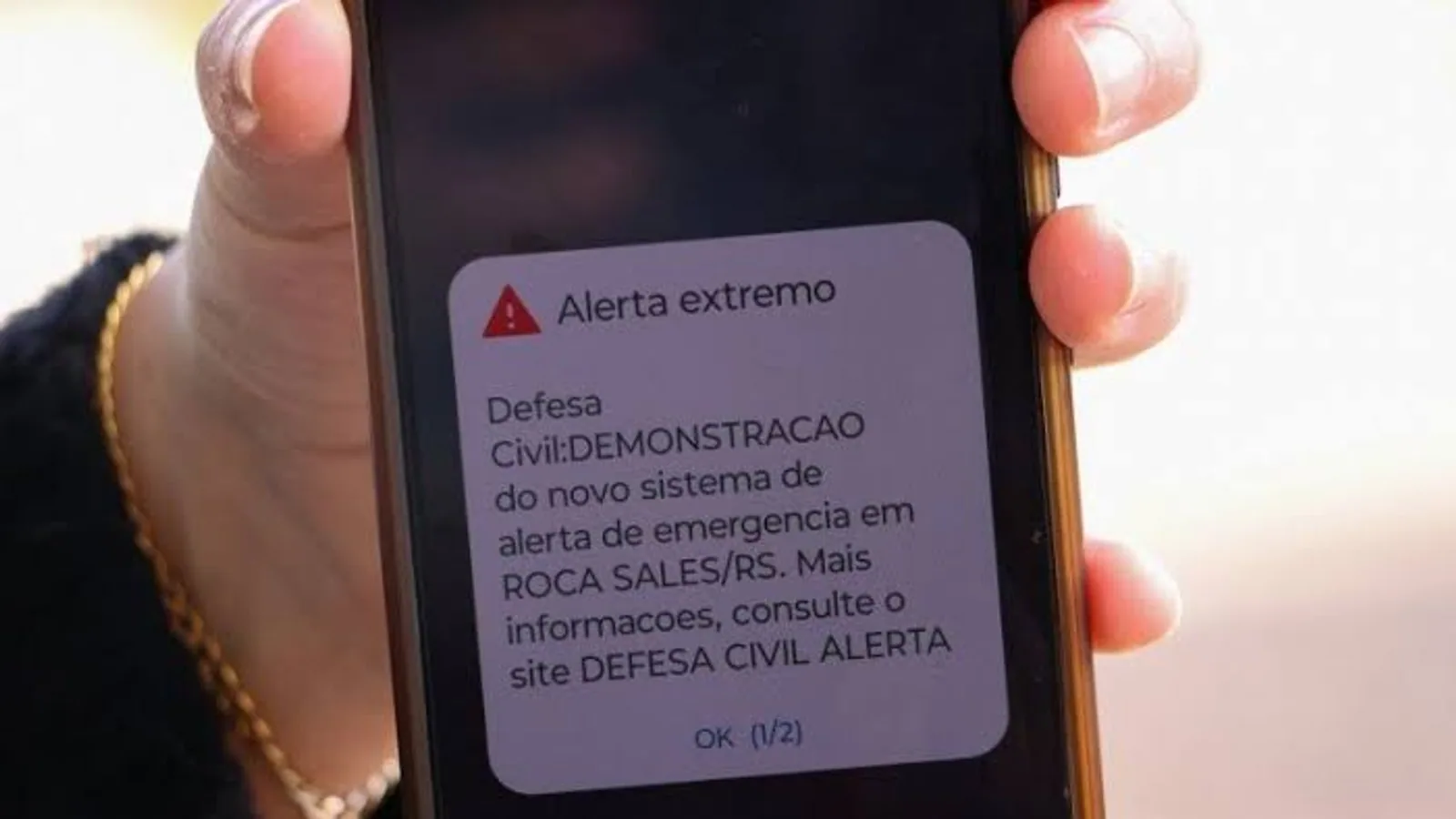
Supercell is not a word from a forgotten meteorology manual: on 2 July 2026, it turned into the reason for INMET to paint southern Brazil red and for millions of phones to ring by themselves in the middle of the night. The phenomenon that spins, lasts for hours and spits out hail and tornadoes is exactly the kind of emergency that the Brazilian government began to communicate through a new system — and a fragile one. This post connects the two points: the real supercell that tested the public alert infrastructure and what it teaches anyone who depends on communication that cannot fail.
TL;DR — what matters in 60 seconds
- A supercell is a rotating thunderstorm that can last up to 6 hours, travel hundreds of kilometres and produce large hail, microbursts and tornadoes. On 30 June 2026, a tornado hit Turvo (PR).
- It triggers the Cell Broadcast, the 'Defesa Civil Alerta' system that has covered all of Brazil since 1 October 2025 and sends messages that pop up on screen even on silent mode.
- The system was born from an Anatel mandate (October 2022) and the Paraná Civil Defence alone has already issued 134 severe weather alerts using it.
- In June 2026, an attack shattered trust: fake alerts with the word 'misantropia' hit phones in 8 states and the platform was taken offline.
- The lesson for businesses and institutions: official channel, authentication and redundancy are not luxuries — they are the difference between being heard and being ignored.
What is a supercell (and why it became a matter of state)
A supercell is the most organised and dangerous form of thunderstorm. What sets it apart from an ordinary downpour is the mesocyclone: a rotating column of air inside the cloud that feeds itself, prolongs the system's life and concentrates energy. While a summer shower fades in minutes, a supercell can last up to six hours and travel tens to hundreds of kilometres, leaving a trail of large hail, destructive gusts and, in the worst case, tornadoes.
That is what southern Brazil saw at the turn of June to July 2026. Between the early hours of 2 July and throughout the day, supercells acted over Santa Catarina, Paraná and Rio Grande do Sul in a feedback process. Before that, on 30 June, a tornado was recorded in Turvo, central Paraná; in Reserva (PR), 11 houses were damaged, four were completely destroyed, about 50 people were affected and ten residents were left homeless. The Santa Catarina Civil Defence also confirmed the formation of a supercell in the Campos Novos region.
When a phenomenon of this magnitude forms, the authorities have minutes, not hours, to warn those in its path. That is when the supercell ceases to be a meteorologist's concern and enters the sphere of legislation and state infrastructure.
Cell Broadcast: the public infrastructure that the supercell activated
The warning that rings on your phone when a supercell approaches has a technical name: Cell Broadcast. Unlike an SMS, which is sent number by number, Cell Broadcast transmits a message to all devices connected to certain antennas — that is, to everyone within the risk area, without needing your number and without relying on a contact list.
In Brazil, the service is called 'Defesa Civil Alerta'. The message appears as a pop-up on the screen, interrupts whatever is being used and plays a distinctive siren, even with the phone on silent. It works on compatible devices connected to 4G or 5G networks, located in areas at risk of disasters such as floods, landslides and — increasingly — severe storms.
Where the obligation came from
It was not a spontaneous initiative by the operators. In October 2022, Anatel determined that mobile phone providers should develop Cell Broadcast technology for sending emergency alerts. From then on, the rollout was gradual: pilot in August 2024 in 11 cities in the South and Southeast, siren from December 2024, Northeast in June 2025, North and Central-West in September 2025 and full national coverage on 1 October 2025.
The number that shows the system in use: the Paraná Civil Defence alone has issued 134 severe weather alerts since the implementation of Cell Broadcast. Each such dispatch is a legal and operational decision — whoever presses the button assumes the responsibility of interrupting the routine of millions of people in the name of public safety.
July 2026: the supercell that put the South on red alert
The July episode was a real test. INMET issued a storm warning with possible supercell formation and, for accumulated rainfall, the red alert — the 'great danger' level, reserved for volumes exceeding 60 mm per hour or 100 mm per day. Experts predicted significant accumulations, hail, wind gusts, microbursts (downdrafts from the cloud) and localised tornado episodes.
The most exposed areas were concentrated in the northwest and north of Rio Grande do Sul, part of the Santa Catarina mountain range and the central-east coast. In this scenario, Cell Broadcast is the difference between a family that closes the doors and gets out of the hail's path and another that only discovers the danger when the window shatters. The technology was built precisely for this moment: full reach, immediate and independent of apps.
The June hack: when the alert turned into 'misantropia'
Only weeks before this legitimate test, the same system made the news for the wrong reason. On the night of 19 and the early hours of 20 June 2026, phones in at least eight capitals — São Paulo, Rio de Janeiro, Belo Horizonte, Brasília, Curitiba, Campo Grande, Rio Branco and Salvador — triggered 'Extreme Alert' warnings with nonsensical messages, including the word 'misantropia' and references to an 'alien attack'.
There were about ten false dispatches in just over an hour, some via Cell Broadcast and others by SMS — the mix of channels reinforced the suspicion of unauthorised access to the system interface. The response was drastic: the Civil Defence took the platform offline in the early hours of Saturday, the Ministry of Integration called in the Federal Police and Anatel declared that the alerts did not follow official channels. The service only returned gradually, with enhanced security.
The damage was not physical, it was to trust. An alert system only works if people believe in it. When the 'Extreme Alert' — reserved for immediate risk to life — is used to play a prank, every future dispatch loses credibility. It is the same mechanism that erodes corporate communication channels when a leak or a scam passes through them. We have written about how an apparently harmless vector can bring down an entire chain's trust in the case of GitHub invaded by a malicious extension and the supply chain attack that swallowed NPM packages.
What the legislation says — Anatel, official channels and responsibility
The supercell and hack cases highlight three legal pillars that apply to any critical communication system, public or private:
- Mandate and standardisation. Anatel did not suggest Cell Broadcast; it mandated it. Regulatory obligation is what ensures that all operators speak the same protocol and that the alert arrives regardless of the chip brand.
- Verifiable official channel. When Anatel states that the fake alerts 'did not follow official channels', it points to the central problem: without strong authentication at the source, any convincing message becomes a legitimate alert in the recipient's eyes.
- Accountability. Calling in the Federal Police and taking the system offline are accountability measures. In emergency communication, getting it wrong has legal consequences — and that is what separates a serious channel from a noticeboard.
For companies and institutions that communicate with the public, the reading is straightforward: what protects a message is not just the content, but the chain of trust behind it.
Timeline of Cell Broadcast in Brazil
| Date | Milestone |
|---|---|
| Oct/2022 | Anatel mandates operators to develop Cell Broadcast |
| Aug/2024 | Pilot in 11 cities in the South and Southeast |
| Dec/2024 | Sound alert (siren) added |
| Jun/2025 | Expansion to the entire Northeast |
| Sep/2025 | Reaches the North and Central-West |
| 1 Oct/2025 | Full national coverage |
| Jun/2026 | Attack with fake alerts temporarily takes the platform offline |
| Jul/2026 | Red alert for supercells in the South tests the system in real operation |
Lessons for those who depend on critical communication
The supercell forced the state to get four things right at the same time: full reach, immediate delivery, clear message and reliable origin. Any business that sends order confirmations, security notices, access codes or expiry alerts faces the same equation — on a smaller scale, but with the same physics.
What can be taken from the episode:
- Reach is not the same as delivery. Cell Broadcast does not depend on the user having an app installed. Your communication should not depend on a single channel that the customer may have uninstalled or silenced.
- Official channel is a strategic asset. Just as Anatel polices who can trigger a national alert, WhatsApp distinguishes between those using the official API and those using workarounds — and treats them very differently.
- Redundancy prevents silence. On the night of the hack, part of the dispatches went out via SMS when Cell Broadcast failed. Having more than one path is what keeps the message alive when the main one falls.
- Trust is fragile. A single misuse — a scam, a leak, a block — destroys years of credibility. Protecting the origin is protecting tomorrow's open rate.
How to build alert channels that people trust
At Agathas Web, the challenge of communicating without failure appears every day — not with supercells, but with messages that need to arrive, be read and be trusted. The same logic as 'Defesa Civil Alerta' translates into three fronts we work on:
Official API: the corporate version of the 'official channel'
Just as only authenticated channels can trigger a national alert, on WhatsApp only the official API guarantees stable delivery, verified sender and lower risk of blocking. If your operation still relies on the common app for important notices, it is worth understanding why that stalls at scale — we explain the difference in the comparison WhatsApp Business App vs Official API.
Push notification: immediate reach without depending on the user opening the app
Cell Broadcast pops up on the screen; push notification does the equivalent inside an app. Well configured, it turns a dormant app into an active warning channel — something we detail in push notifications in Moodle and engagement. For schools, courses and companies, it is the way to reach the audience without hoping they open the email.
Redundant architecture
A serious communication system never bets everything on one channel. We combine official API, push, transactional email and webhooks so that the critical message has more than one path to the recipient — the same philosophy that made SMS serve as a plan B when Cell Broadcast went down.
Conclusion: the supercell passes, the infrastructure remains
The supercell of July 2026 will become a statistic of another severe winter in the South. What remains is the alert infrastructure it tested — and the lesson that communicating in critical moments is as much a matter of technology as of trust and responsibility. The state learned this the hard way, between a real tornado and an embarrassing hack.
If your institution depends on messages that cannot be lost, the next step is to audit the channels you use today: do they have a verifiable origin? Do they have a plan B? Do they arrive even when the customer forgot to open the app? If the answer is uncertain, talk to Agathas Web — we help build the corporate version of that 'Defesa Civil Alerta', without waiting for the storm to arrive.
Related posts
H-1B Visa 2026: Restrictions, Fees and Remote Talent
Fraud investigation, £80,000 fee and salary-based selection: the H-1B visa changed in 2026 — and opened the door for remote dev teams.

Galicia Official Gazette: How to Monitor with AI in 2026
Missing a notice in the DOG can cost you a deadline or a public grant. See how AI turns the Galician official gazette into actionable alerts.
HMRC Error: 15 Years Overcharging Pensioners
A 2010 bug in the UK tax authority's system overcharged 1.4 million pensioners. The engineering lesson behind the scandal.